Calibration of Bayesian one-stage designs for single-arm phase II trials with binary endpoints
Riko
Kelter
Institute of Medical Statistics and Computational Biology
Faculty of Medicine, University of Cologne
Cologne, Germany
15 September 2026
Source:vignettes/bfbin2arm-singlearm-onestage.Rmd
bfbin2arm-singlearm-onestage.RmdIntroduction
This vignette illustrates how to calibrate a one-stage single-arm Bayes factor design for a binary endpoint. The goal is to determine the smallest total sample size that satisfies pre-specified Bayesian and/or frequentist operating characteristics. The underlying statistical theory is developed in (kelter_third_2025?), extended to the single-arm two-stage optimal setting in (kelter_two_stage_2025?), and further developed to the two-arm single-stage setting in (kelter_power_2026?).
How to design a Bayesian trial: Overview of the calibration algorithm
The workflow implemented in the package follows the fixed-sample Bayes factor calibration framework proposed in (kelter_third_2025?): Choose design and analysis priors, specify an evidence threshold on the scale, compute operating characteristics as a function of the sample size, and select the smallest feasible design.
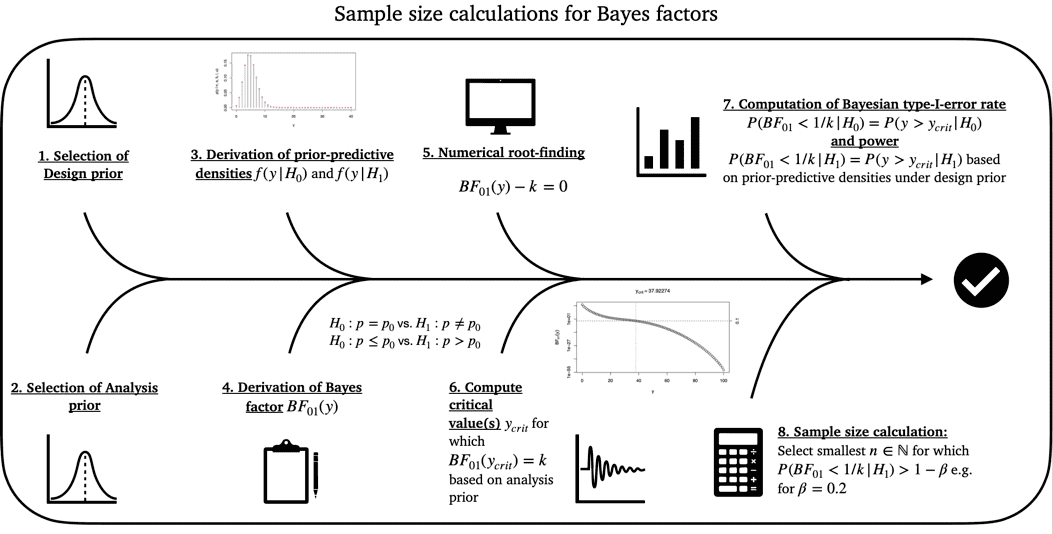
Figure 1: Illustration of the calibration algorithm for an optimal Bayesian single-arm phase II design with a binary endpoint
Figure 1 visualizes the calibration methodology in detail. Based on the selected design and analysis priors, the prior predictive and the Bayes factor, the critical value is found via numerical root finding (step 5. and 6. in Figure 1). Based on this critical value, in the single-arm setting, the relationship
holds for both hypotheses , . When , this implies one can easily calculate the Bayesian type-I-error rate as
while for , the latter becomes the Bayesian power:
For specified target constraints and , one can then calculate the smallest , for which and
A further metric for calibration is the probability of compelling evidence
which can likewise be calibrated to achieve at least a threshold . Here, the event can be interpreted as the Bayes factor providing sufficient evidence in favour of , when is indeed true. If this probability is calibrated, additionally to Bayesian type-I-error rate and power, one can be certain when the trial is carried out, the event is reached with probability when indeed holds. Thus, when the null hypothesis is true we will often find sufficient evidence to really accept instead of remaining indecisive about whether or is true.
Basic calibration
We consider a phase II setting with null response probability
p0 = 0.2 and an efficacy threshold k = 1/3 on
the scale. We assume slightly optimistic design priors via
da1 = 2.5 and db1 = 2 under
,
a flat design prior under
,
specified via da0 = 1 and db0 = 1, and flat
analysis priors under both
and
(specified via a0 = 1, b0 = 1,
a1 = 1 and b1 = 1). We test the hypotheses
against each other, so we use the argument
type = "direction" and set p0 = 0.2. We limit
the sample size range to the minimum and maximum values
n_min = 10 and n_max = 200, and require 80%
Bayesian power, specified via target_power = 0.80. Also, we
require a Bayesian type-I-error rate of 5% or less, specified via the
argument target_type1 = 0.05:
library(bfbin2arm)

des_bayes <- design_singlearm_onestage_bf(
  n_min = 10,
  n_max = 200,
  k = 1/3,
  p0 = 0.2,
  a0 = 1, b0 = 1,
  a1 = 1, b1 = 1,
  da0 = 1, db0 = 1,
  da1 = 2.5, db1 = 2,
  type = "direction",
  calibration = "Bayesian",
  target_power = 0.8,
  target_type1 = 0.05
)
We can inspect the results as follows:
summary(des_bayes)
#> Summary: One-stage single-arm Bayes factor design
#> ------------------------------------------------
#> Calibration: Bayesian
#> Sustain:  10  future n
#> Feasible : TRUE
#> Status : Smallest feasible one-stage design found.
#>
#> Selected design
#>  n    : 13
#>  k    : 0.333
#>
#> Operating characteristics
#>  Bayes power  : 0.821
#>  Bayes type-I : 0.021
#>  CE(H0)       :   NA
#>  Freq power   :   NA
#>  Freq type-I  : 0.099
Operating-characteristic curves
The search results can be visualized directly.
plot(des_bayes)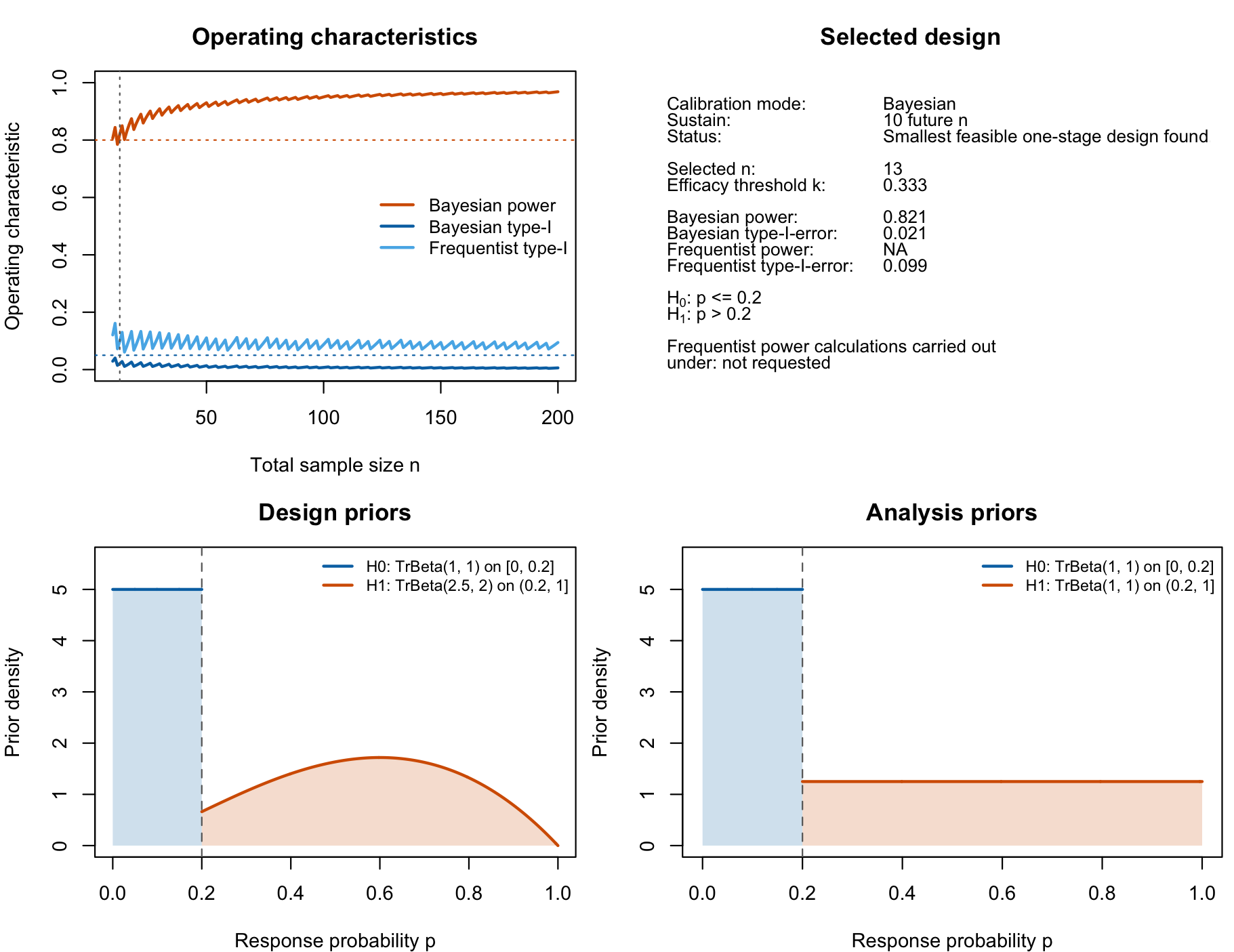
Figure 2: Visualization of the calibrated Bayesian single-arm one-stage phase II design with a binary endpoint
The top left panel shows Bayesian power and type-I error, together with optional frequentist overlays if a point alternative is supplied.
The top right panel shows the relevant operating characteristics of the trial design isolated by the calibration algorithm. In this case, no frequentist power calculations were required, so the frequentist power is shown as NA (not available), and the lower part states that frequentist power calculations under a point alternative were not requested. We can quickly see that Bayesian power and type-I-error rate are calibrated for already, so when choosing the evidence threshold , patients suffice to yield a calibrated Bayesian design. Also, the output shows that this design is not calibrated in terms of the frequentist type-I-error rate, which is computed via a grid-search and in this case is .
Note that the beta-binomial model induces the zig-zag shape of the
resulting curves for the operating characteristics such as power and
type-I-error rate. As a consequence, the calibration algorithm by
default requires the power not to drop below the specified target
threshold for the next ten sample sizes. This is also customisably via
the parameter sustain_n, which is also shown in the summary
output above in form of the text “Sustain: 10 future n”.
Adding a constraint on the probability of compelling evidence
Next, we could add a constraint on the probability of compelling
evidence for
.
An optional CE(H0) constraint can be imposed through
target_ce_h0. This is useful when one also wants the design
to have a sufficient probability of yielding compelling evidence in
favour of the null hypothesis
for some
and futility evidence threshold
.
Now, we use
and
,
specified via the arguments target_ce_h0 = 0.60 and
k_ce = 3. Everything else remains the same, but we also add
the argument dp = 0.4 to compute frequentist power under
the point alternative
:
des_bayes_ce <- design_singlearm_onestage_bf(
  n_min = 10,
  n_max = 200,
  k = 1/3,
  p0 = 0.2,
  a0 = 1, b0 = 1,
  a1 = 1, b1 = 1,
  da0 = 1, db0 = 1,
  da1 = 2.5, db1 = 2,
  type = "direction",
  calibration = "Bayesian",
  target_power = 0.8,
  target_type1 = 0.05,
  target_ce_h0 = 0.6,
  k_ce = 3,
  dp = 0.4
)
We inspect the results:
summary(des_bayes_ce)
#> Summary: One-stage single-arm Bayes factor design
#> ------------------------------------------------
#> Calibration: Bayesian
#> Sustain:  10  future n
#> Feasible : TRUE
#> Status : Smallest feasible one-stage design found.
#>
#> Selected design
#>  n    : 13
#>  k    : 0.333
#>  k_ce :    3
#>
#> Operating characteristics
#>  Bayes power  : 0.821
#>  Bayes type-I : 0.021
#>  CE(H0)       : 0.825
#>  Freq power   : 0.647
#>  Freq type-I  : 0.099
Since we added the parameter dp = 0.4 to the above
function call, frequentist power is additionally calculated under the
point alternative
in the single-arm case. We can always add this to a design calibration,
but the calibration mode (specified via the argument
calibration) decides which metric is the benchmark for
finding a feasible design (that is, a sufficiently large sample size to
meet our specified target constraints). Thus, frequentist power is
calculated here solely post-hoc for the calibrated design. The
calibrated design itself is calibrated according to the Bayesian target
power and type-I-error rate. We can see the resulting sample size in the
above output, and we can plot the design as follows:
plot(des_bayes_ce)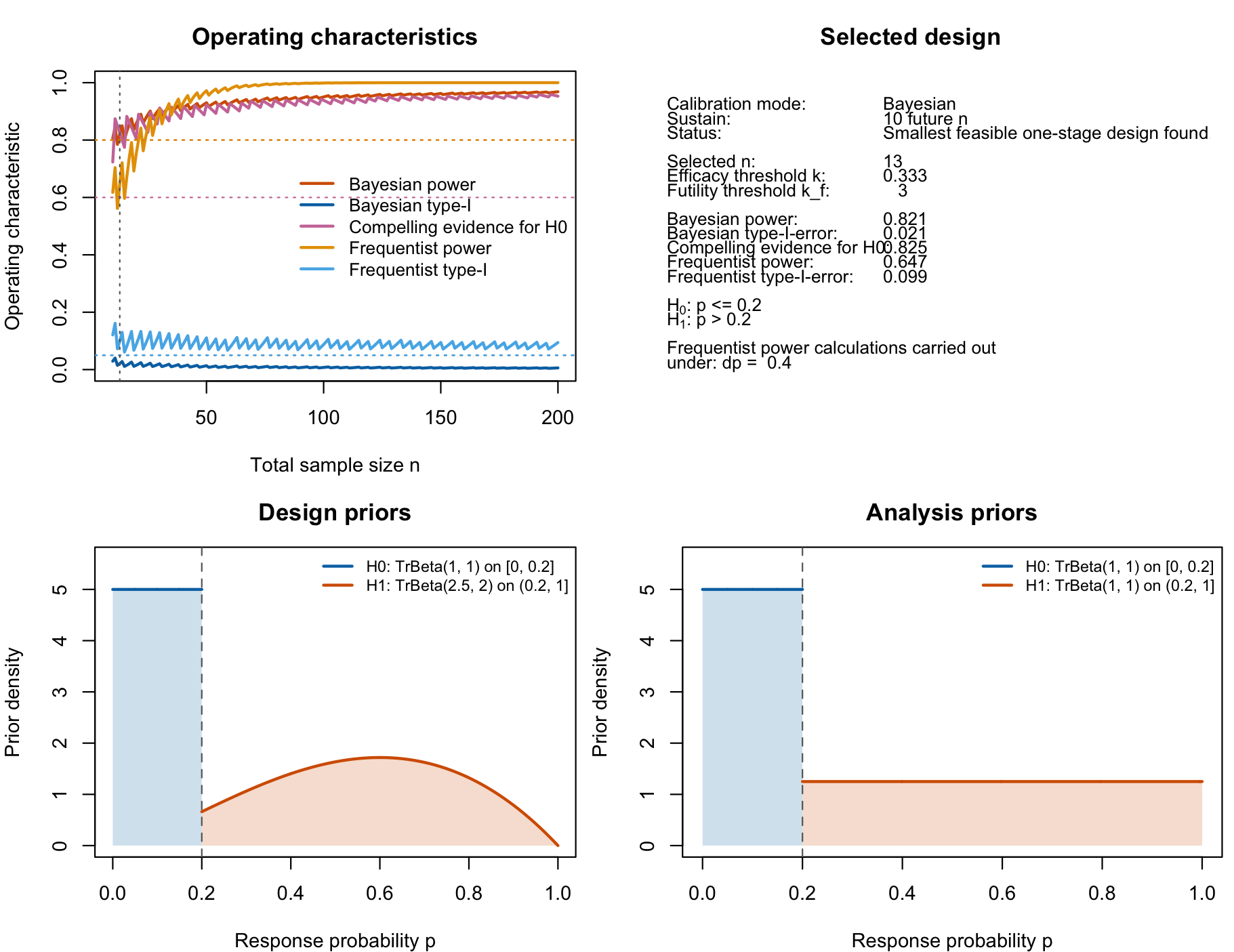
Figure 3: Visualization of the calibrated Bayesian single-arm one-stage phase II design with a binary endpoint. In contrast to the earlier Bayesian calibration for power and type-I-error rate, now an additional constraint fo the probability of compelling evidence is added.
If we increase the requirement on probability of compelling evidence for to, say, 90%, we get:
des_bayes_ce90 <- design_singlearm_onestage_bf(
  n_min = 10,
  n_max = 200,
  k = 1/3,
  p0 = 0.2,
  a0 = 1, b0 = 1,
  a1 = 1, b1 = 1,
  da0 = 1, db0 = 1,
  da1 = 2.5, db1 = 2,
  type = "direction",
  calibration = "Bayesian",
  target_power = 0.8,
  target_type1 = 0.05,
  target_ce_h0 = 0.9,
  k_ce = 3,
  dp = 0.4
)
We inspect the fit:
summary(des_bayes_ce90)
#> Summary: One-stage single-arm Bayes factor design
#> ------------------------------------------------
#> Calibration: Bayesian
#> Sustain:  10  future n
#> Feasible : TRUE
#> Status : Smallest feasible one-stage design found.
#>
#> Selected design
#>  n    : 60
#>  k    : 0.333
#>  k_ce :    3
#>
#> Operating characteristics
#>  Bayes power  : 0.928
#>  Bayes type-I : 0.008
#>  CE(H0)       : 0.927
#>  Freq power   : 0.978
#>  Freq type-I  : 0.077
We can plot the resulting design:
plot(des_bayes_ce90)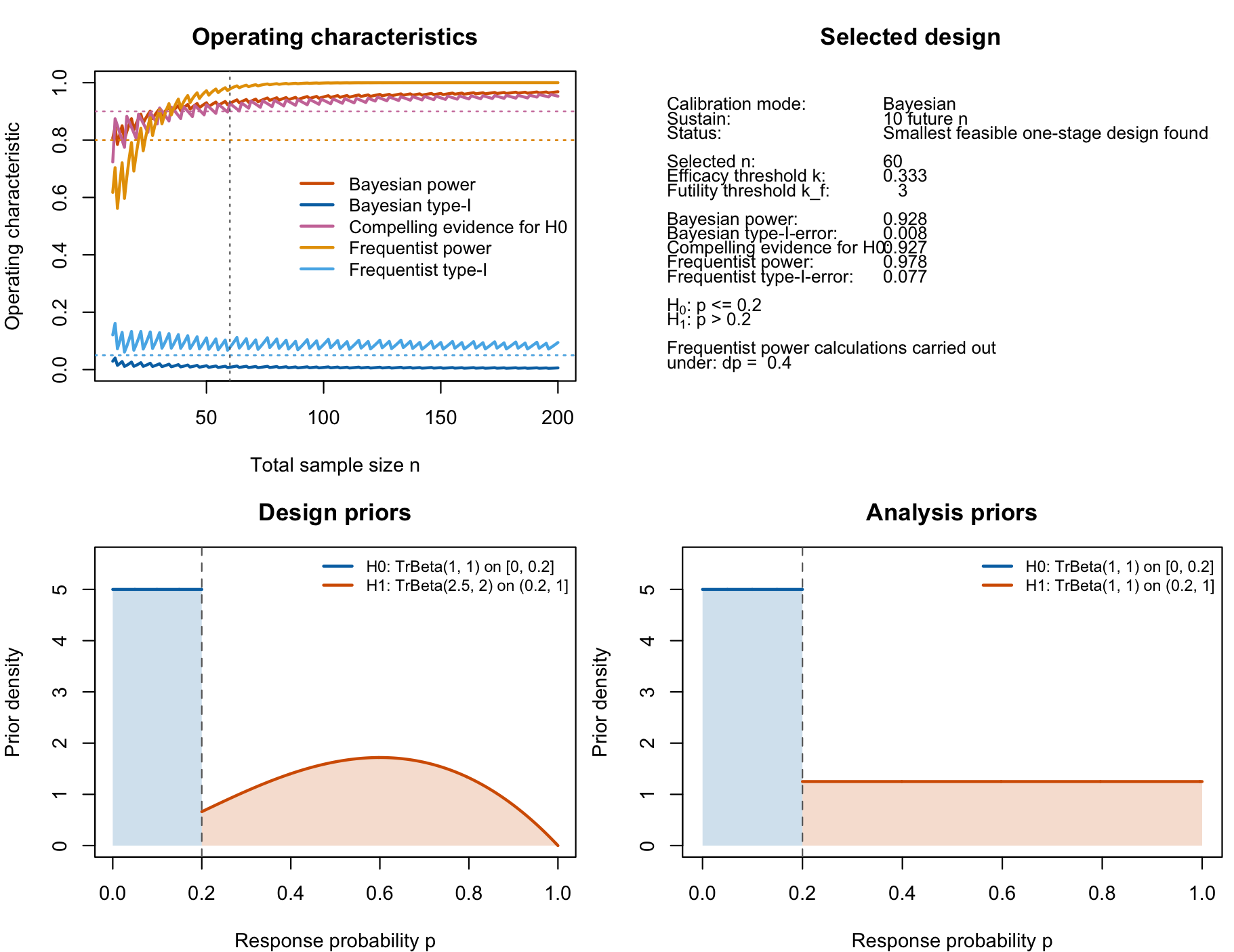
Figure 3: Visualization of the calibrated Bayesian single-arm one-stage phase II design with a binary endpoint. In contrast to the previous Bayesian calibration, the target probability of compelling evidence for the null hypothesis is increased to 90% now.
Full Bayes-frequentist calibration
The same interface also supports frequentist and fully joint
calibration modes. We change calibration = "Bayesian" to
calibration = "full", and specify our target constraints
for frequentist power and type-I-error rate via the arguments
target_freq_power = 0.8 and
target_freq_type1 = 0.05.
des_full <- design_singlearm_onestage_bf(
  n_min = 10,
  n_max = 100,
  k = 1/3,
  p0 = 0.2,
  a0 = 1, b0 = 1,
  a1 = 1, b1 = 1,
  dp = 0.4,
  da0 = 1, db0 = 1,
  da1 = 2.5, db1 = 2,
  type = "direction",
  calibration = "full",
  target_power = 0.8,
  target_type1 = 0.05,
  target_freq_power = 0.8,
  target_freq_type1 = 0.05
)

summary(des_full)
#> Summary: One-stage single-arm Bayes factor design
#> ------------------------------------------------
#> Calibration: full
#> Sustain:  10  future n
#> Feasible : FALSE
#> Status : No feasible one-stage design found.
Now, given our priors and evidence thresholds no feasible one-stage design was found in the specified sample size range. We can see the reason for this by inspecting
head(des_full$search_results)
#>    n     power      type1 ce_h0 power_naive type1_naive erased_power
#> 1 10 0.8065237 0.02925913    NA   0.8065237  0.02925913            0
#> 2 11 0.8438969 0.04026381    NA   0.8438969  0.04026381            0
#> 3 12 0.7849683 0.01482212    NA   0.7849683  0.01482212            0
#> 4 13 0.8206335 0.02085515    NA   0.8206335  0.02085515            0
#> 5 14 0.8498421 0.02813328    NA   0.8498421  0.02813328            0
#> 6 15 0.8016997 0.01109326    NA   0.8016997  0.01109326            0
#>   erased_type1 freq_power freq_type1 freq_power_naive freq_type1_naive
#> 1            0  0.6177194 0.12087388        0.6177194       0.12087388
#> 2            0  0.7037157 0.16113920        0.7037157       0.16113920
#> 3            0  0.5618218 0.07255550        0.5618218       0.07255550
#> 4            0  0.6469582 0.09913061        0.6469582       0.09913061
#> 5            0  0.7207430 0.12983963        0.7207430       0.12983963
#> 6            0  0.5967844 0.06105143        0.5967844       0.06105143
#>   erased_freq_power erased_freq_type1 bayes_ok freq_ok hybrid_ok feasible_ce
#> 1                 0                 0     TRUE   FALSE     FALSE        TRUE
#> 2                 0                 0     TRUE   FALSE     FALSE        TRUE
#> 3                 0                 0    FALSE   FALSE     FALSE        TRUE
#> 4                 0                 0     TRUE   FALSE     FALSE        TRUE
#> 5                 0                 0     TRUE   FALSE     FALSE        TRUE
#> 6                 0                 0     TRUE   FALSE     FALSE        TRUE
#>   feasible_pointwise feasible calibration
#> 1              FALSE    FALSE        full
#> 2              FALSE    FALSE        full
#> 3              FALSE    FALSE        full
#> 4              FALSE    FALSE        full
#> 5              FALSE    FALSE        full
#> 6              FALSE    FALSE        full
We can quickly see that the frequentist type-I-error of all designs is simply too large:
range(des_full$search_results$freq_type1)
#> [1] 0.06105143 0.16113920
Increasing the evidence threshold
leads to the situation that it becomes harder for the Bayes factor to
accumulate evidence in favour of
,
thus also decreasing the type-I-error rates (both the Bayesian and
frequentist ones). Thus, we refit our design as follows by changing
k = 1/3 to k = 1/10:
des_full_strong_ev <- design_singlearm_onestage_bf(
  n_min = 10,
  n_max = 100,
  k = 1/10,
  p0 = 0.2,
  a0 = 1, b0 = 1,
  a1 = 1, b1 = 1,
  dp = 0.4,
  da0 = 1, db0 = 1,
  da1 = 2.5, db1 = 2,
  type = "direction",
  calibration = "full",
  target_power = 0.8,
  target_type1 = 0.05,
  target_freq_power = 0.8,
  target_freq_type1 = 0.05
)
We investigate the fit:
summary(des_full_strong_ev)
#> Summary: One-stage single-arm Bayes factor design
#> ------------------------------------------------
#> Calibration: full
#> Sustain:  10  future n
#> Feasible : TRUE
#> Status : Smallest feasible one-stage design found.
#>
#> Selected design
#>  n    : 38
#>  k    :  0.1
#>
#> Operating characteristics
#>  Bayes power  : 0.866
#>  Bayes type-I : 0.003
#>  CE(H0)       :   NA
#>  Freq power   : 0.814
#>  Freq type-I  : 0.029
We plot the fit:
plot(des_full_strong_ev)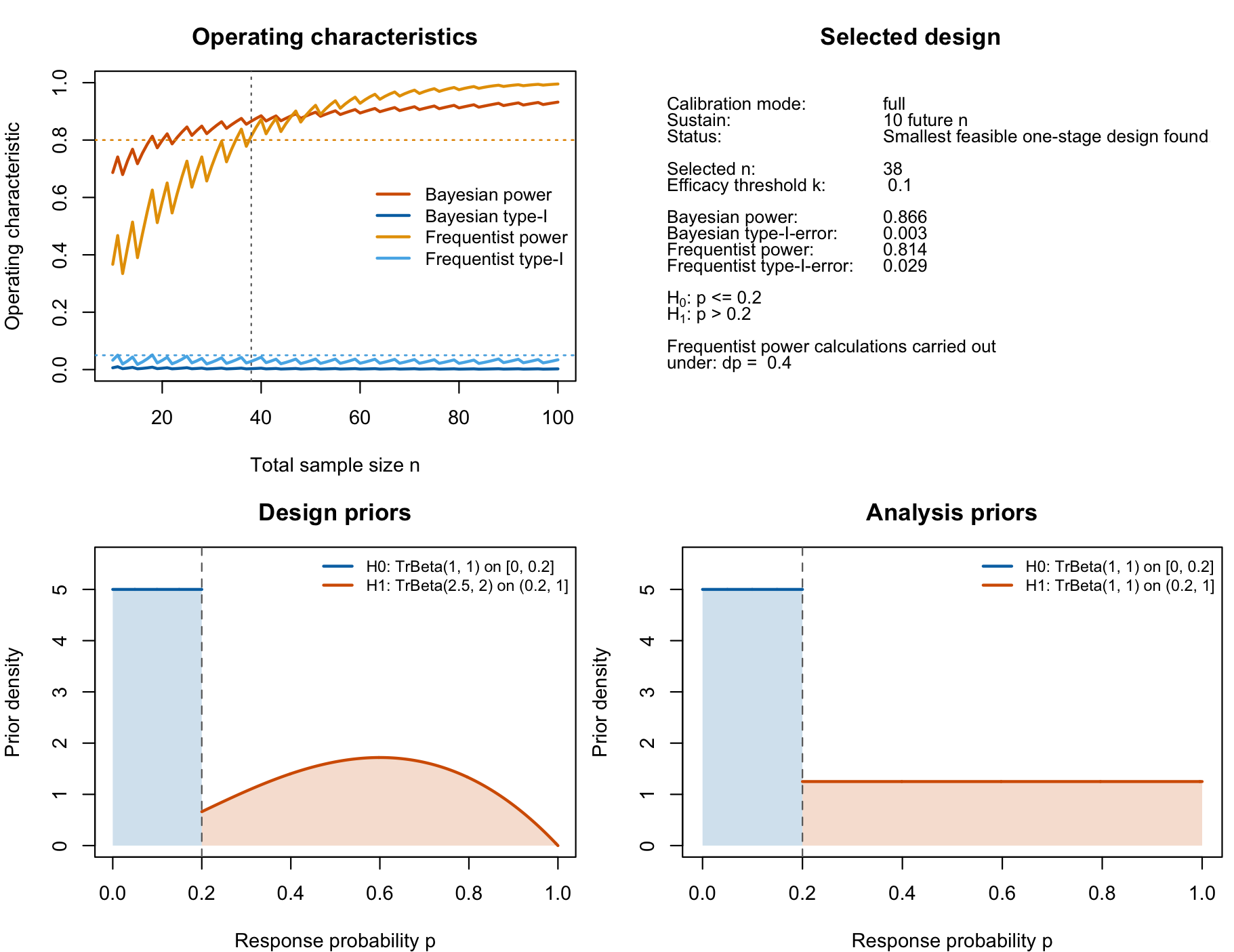
Figure 4: Visualization of the fully calibrated single-arm one-stage phase II design with a binary endpoint. In contrast to the previous Bayesian calibration, both Bayesian and frequentist operating characteristics are calibrated now.
Frequentist calibration
We turn to frequentist calibration of our design, and build upon the
fully calibrated design above. We change the calibration mode
accordingly to frequentist:
des_freq_strong_ev <- design_singlearm_onestage_bf(
  n_min = 10,
  n_max = 100,
  k = 1/10,
  p0 = 0.2,
  a0 = 1, b0 = 1,
  a1 = 1, b1 = 1,
  dp = 0.4,
  da0 = 1, db0 = 1,
  da1 = 2.5, db1 = 2,
  type = "direction",
  calibration = "frequentist",
  target_power = 0.8,
  target_type1 = 0.05,
  target_freq_power = 0.8,
  target_freq_type1 = 0.05
)

summary(des_freq_strong_ev)
#> Summary: One-stage single-arm Bayes factor design
#> ------------------------------------------------
#> Calibration: frequentist
#> Sustain:  10  future n
#> Feasible : TRUE
#> Status : Smallest feasible one-stage design found.
#>
#> Selected design
#>  n    : 38
#>  k    :  0.1
#>
#> Operating characteristics
#>  Bayes power  : 0.866
#>  Bayes type-I : 0.003
#>  CE(H0)       :   NA
#>  Freq power   : 0.814
#>  Freq type-I  : 0.029
Note in the above call, that the arguments
target_power = 0.8 and target_type1 = 0.05
could also be removed, as they play no role when the calibration
parameter is set to frequentist. target_power
and target_type1 only specify the target constraints for
calibration modes which involve a Bayesian component like
calibration = "Bayesian",
calibration = "hybrid" or
calibration = "full".
Based on the summary output we see that the design which is calibrated in terms of frequentist type-I-error and power is also fully calibrated. This can also be seen from the last plot, because the Bayesian type-I-error and power meet their respective target constraints for already smaller sample size. The limiting factor in the fully calibrated design thus is the frequentist power, which is only achieved for (see the left panel in the last plot above).
Hybrid calibration
An interesting alternative is hybrid calibration. We do not provide
detailed information here, but the core idea is to report Bayesian
power, which often is more realistic than frequentist power under a
specific point alternative, and frequentist type-I-error. Thus, from a
regulatory perspective, the frequentist type-I-error is often the
limiting or hard factor that must be met, as it constitutes a worst-case
scenario, but Bayesian power might be more realistic under a slightly
informative design prior. We set the calibration mode to
hybrid:
des_hybrid_strong_ev <- design_singlearm_onestage_bf(
  n_min = 10,
  n_max = 100,
  k = 1/10,
  p0 = 0.2,
  a0 = 1, b0 = 1,
  a1 = 1, b1 = 1,
  dp = 0.4,
  da0 = 1, db0 = 1,
  da1 = 2.5, db1 = 2,
  type = "direction",
  calibration = "hybrid",
  target_power = 0.8,
  target_type1 = 0.05,
  target_freq_power = 0.8,
  target_freq_type1 = 0.05
)

summary(des_hybrid_strong_ev)
#> Summary: One-stage single-arm Bayes factor design
#> ------------------------------------------------
#> Calibration: hybrid
#> Sustain:  10  future n
#> Feasible : TRUE
#> Status : Smallest feasible one-stage design found.
#>
#> Selected design
#>  n    : 23
#>  k    :  0.1
#>
#> Operating characteristics
#>  Bayes power  : 0.809
#>  Bayes type-I : 0.004
#>  CE(H0)       :   NA
#>  Freq power   : 0.612
#>  Freq type-I  : 0.027
We see that now the feasible sample size to calibrate our design has changed from to only . Thus, the hybrid design required fewer patients.
plot(des_hybrid_strong_ev)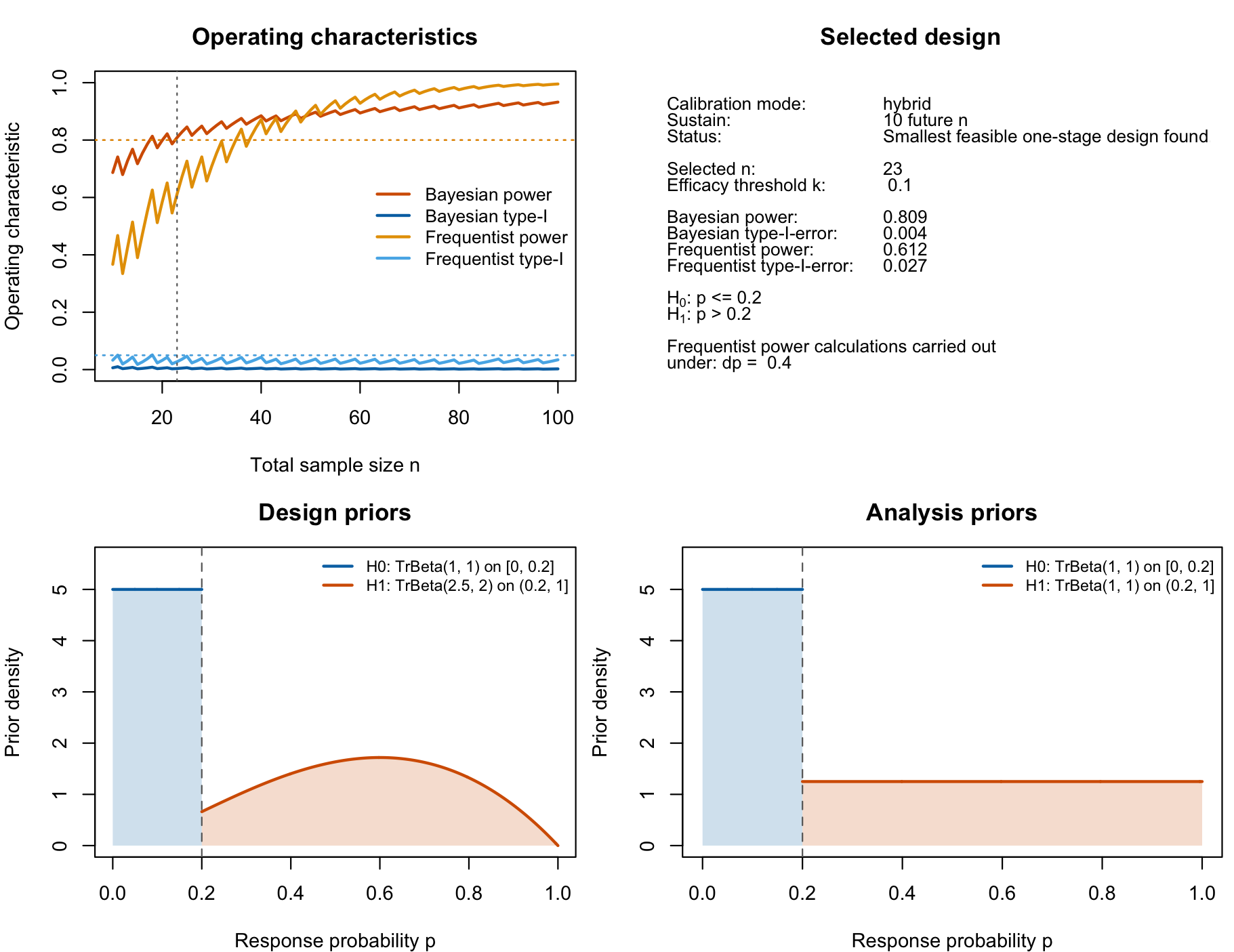
Figure 5: Visualization of the hybrid calibrated single-arm one-stage phase II design with a binary endpoint. In contrast to the previous calibration, Bayesian power is calibrated with frequentist type-I-error in this calibration mode.
The plot clearly shows that Bayesian power is the limiting factor here: From patients on, it passes the required 80% threshold. Bayesian and frequentist type-I-error are controlled for even smaller sample sizes, and from our previous fully and frequentist calibration results we know that frequentist power achieves the required 80% target power only for . Thus, shifting to a Bayesian notion of power under the slightly informative design priors under yields a reduction in sample size of patients, which is non-negligible.
We could also add a probability of compelling evidence constraint to
that design by adding the arguments k_ce = 3 and
target_ce_h0 = 0.60, indicating we require at least 60%
probability of compelling evidence for
based on a evidence threshold
:
des_hybrid_strong_ev_with_ce <- design_singlearm_onestage_bf(
  n_min = 10,
  n_max = 100,
  k = 1/10,
  k_ce = 3,
  p0 = 0.2,
  a0 = 1, b0 = 1,
  a1 = 1, b1 = 1,
  dp = 0.4,
  da0 = 1, db0 = 1,
  da1 = 2.5, db1 = 2,
  type = "direction",
  calibration = "hybrid",
  target_power = 0.8,
  target_type1 = 0.05,
  target_ce_h0 = 0.6,
  target_freq_power = 0.8,
  target_freq_type1 = 0.05
)

summary(des_hybrid_strong_ev_with_ce)
#> Summary: One-stage single-arm Bayes factor design
#> ------------------------------------------------
#> Calibration: hybrid
#> Sustain:  10  future n
#> Feasible : TRUE
#> Status : Smallest feasible one-stage design found.
#>
#> Selected design
#>  n    : 23
#>  k    :  0.1
#>  k_ce :    3
#>
#> Operating characteristics
#>  Bayes power  : 0.809
#>  Bayes type-I : 0.004
#>  CE(H0)       : 0.859
#>  Freq power   : 0.612
#>  Freq type-I  : 0.027
We see that still patients are required.
plot(des_hybrid_strong_ev_with_ce)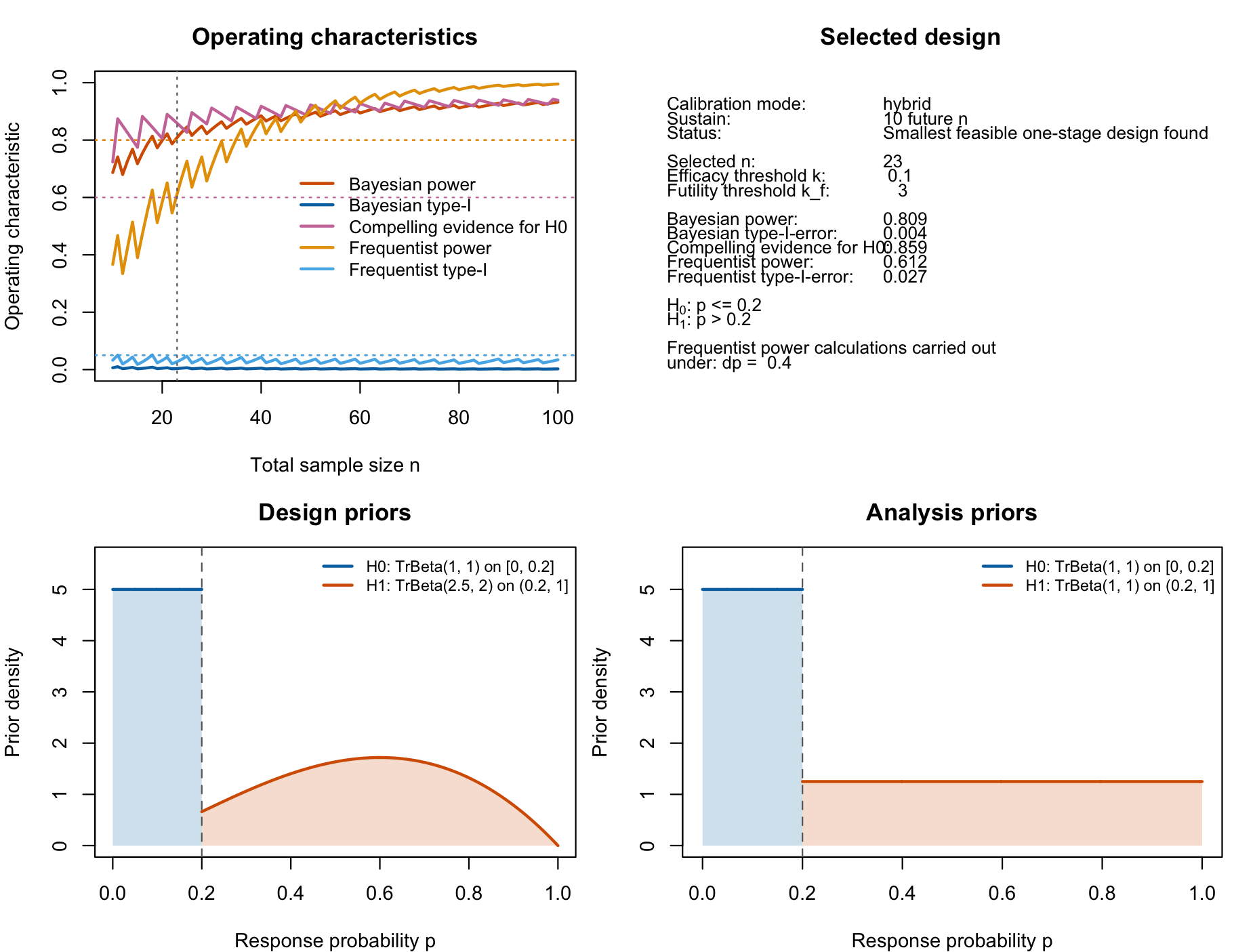
Figure 6: Visualization of the hybrid calibrated single-arm one-stage phase II design with a binary endpoint, this time with an additional constraint on the probability of compelling evidence for the null hypothesis.
Relationship to the two-stage design
The one-stage design can be viewed as the fixed-sample baseline. In
the package, the function design_singlearm_bf() extends
this framework to a two-stage design with one interim analysis and early
stopping for futility.
Summary
In this vignette we demonstrated how to calibrate one-stage single-arm Bayes factor designs for phase II trials with binary endpoints using the functions provided in the bfbin2arm package. The calibration framework combines design and analysis priors, Bayes-factor evidence thresholds, and target operating characteristics into a fully numerical search over the total sample size. Within this framework, users can work in purely Bayesian, purely frequentist, or hybrid modes, and optionally impose an additional constraint on the probability of compelling evidence in favour of the null hypothesis.
We illustrated how to obtain the smallest feasible design under
Bayesian calibration, and how to visualize the resulting
operating-characteristic curves via the dedicated plotting method. We
also showed how to extend the calibration by adding a probability of
compelling evidence (CE) constraint, and how the chosen futility
threshold
(the parameter k_ce) and the target level for the
probability of compelling evidence interact with the achievable power
and type-I error in a given sample size range. Finally, we discussed the
sustain parameter sustain_n, which requires that the chosen
design remains feasible for a number of larger sample sizes and thus
guards against local beta–binomial oscillations in the operating
characteristics.